
NAD+ Research Guide | Cellular Metabolism & Mitochondrial Function Explained


Few molecules in cellular biology have attracted as much sustained research attention over the past decade as NAD+ (nicotinamide adenine dinucleotide). It sits at the centre of energy metabolism, DNA repair signalling, and a family of enzymes implicated in ageing biology, which is exactly why it shows up so often in both serious research literature and considerably less rigorous wellness marketing. This guide sets out what NAD+ actually does at the cellular level, what recent human and animal research has found, and, just as importantly, what the current evidence base does not yet support.
What Is NAD+ and Why Does Research Interest Keep Growing?
NAD+ is a coenzyme present in every living cell, where it acts as an electron carrier in redox reactions, cycling between its oxidised (NAD+) and reduced (NADH) forms to shuttle electrons through core metabolic pathways. Beyond this classic energy-metabolism role, NAD+ is also a required substrate for sirtuins and PARP enzymes, which use it to drive processes linked to DNA repair and cellular stress responses. A comprehensive 2024 review in Nature Reviews Molecular Cell Biology describes NAD+ metabolism as sitting at a genuine intersection of energy production and cell-signalling biology, which is precisely why interest in it spans metabolic research, neuroscience, and ageing biology rather than any single field.
The sirtuin family (SIRT1 through SIRT7) is a particularly active area of that research. These enzymes use NAD+ as a required cofactor to remove acetyl groups from target proteins, a modification that influences gene expression, mitochondrial biogenesis, and cellular stress resistance. PARP enzymes draw on the same NAD+ pool for a different purpose, repairing damaged DNA. Because both enzyme families compete for the same finite NAD+ supply within a cell, researchers have proposed that a cell’s available NAD+ pool functions as a kind of shared resource governing how much capacity is left over for repair and regulatory signalling versus basic energy production, a framework that’s driven much of the current interest in measuring and modulating NAD+ levels experimentally.

NAD+ and Cellular Energy Production
At the biochemical level, NAD+/NADH cycling is central to glycolysis, the citric acid cycle, and oxidative phosphorylation, the sequence of reactions mitochondria use to generate ATP, the cell’s primary energy currency. Without a sufficient functional pool of NAD+, this electron-transport chain simply cannot run efficiently, which is why NAD+ availability is often described in the literature as a rate-limiting factor for mitochondrial energy output rather than a peripheral detail of metabolism.

The Age-Related NAD+ Decline Hypothesis
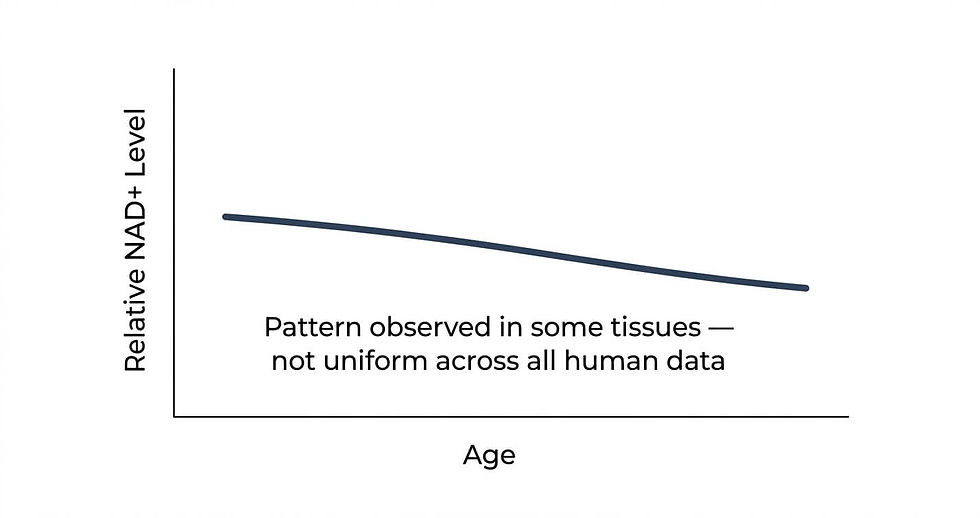
One of the most-cited observations in this field is that NAD+ levels appear to fall with age in several tissue types, a pattern first characterised in animal models. However, a 2025 review is careful to note that this decline is not uniform across all human tissues and remains an area requiring substantially more direct human data before firm conclusions can be drawn, since most of the foundational decline data comes from rodent and nematode studies rather than large human cohorts. This is an important nuance; the popular framing of NAD+ decline as a simple, universal ageing clock is considerably more contested in the primary literature than in consumer health content.
Part of the difficulty is that NAD+ metabolism itself differs somewhat between species, the enzymes responsible for synthesising and consuming NAD+ don’t operate identically in mice and humans, which makes direct extrapolation of rodent findings into expected human outcomes scientifically risky rather than a simple matter of scaling a dose. This is exactly the kind of translational gap that well-designed human trials exist to close, and why review authors have specifically called for more direct human tissue data before treating the decline hypothesis as settled.
NAD+ vs. NAD+ Precursors: An Important Distinction
Much of the human clinical research in this space has actually tested NAD+ precursors, nicotinamide riboside (NR) and nicotinamide mononucleotide (NMN), rather than NAD+ itself, largely because these smaller precursor molecules are more practical to administer and study. A 2025 randomised, placebo-controlled human study published in Nature Metabolism directly compared NR, NMN, and nicotinamide (Nam) over 14 days and found that NR and NMN, but not Nam, comparably increased circulating NAD+ concentrations in healthy adults. Direct NAD+ administration is a separate, smaller body of research, it is being studied in specific clinical contexts, including an ongoing interventional trial registered on ClinicalTrials.gov examining intravenous NAD+ in a haematological condition, but this is disease-specific investigational research rather than evidence generalisable to research use of NAD+ as a compound.

What Human Clinical Evidence Currently Shows
A PRISMA-guided systematic review covering January 2010 to October 2025 identified 113 eligible studies, 33 in humans and 80 in rodents. Its summary is worth stating plainly; in human studies, oral NAD+ precursors consistently raised measurable NAD-related biomarkers and were generally well tolerated, but their effects on functional, metabolic, and vascular outcomes were heterogeneous and often null or endpoint-specific. In other words, raising a measurable biomarker in the blood is well established; translating that into a clear, consistent functional outcome in humans is not yet settled science. Rodent studies in the same review more frequently reported improvements across metabolic, mitochondrial, and inflammatory endpoints, but preclinical animal results are not equivalent to demonstrated human outcomes.

Why NAD+ Research Has Expanded Beyond Metabolism
NAD+ research is no longer confined to metabolic biology alone. A 2025 conference report from the FASEB Scientific Research Conference on NAD Metabolism and Signaling, with contributing researchers from institutions including Washington University, the University of Bergen’s Neuro-SysMed centre, and the NIH, described the field’s current trajectory as moving deliberately “from bench to clinic,” with active research interest spanning neurodegenerative disease contexts such as Parkinson’s disease alongside the more established metabolic and mitochondrial research lines. This broadening reflects NAD+’s role as a shared cofactor across multiple cell-signalling systems rather than a single-pathway molecule, but it also means claims about NAD+ research now span a wider and more heterogeneous evidence base than metabolic research alone, making it more important, not less, to check which specific outcome a given study actually measured.

What the Evidence Does Not Yet Establish
Given how this research area is often discussed in wellness content, it’s worth being explicit about where the evidence stops. The current literature does not establish that NAD+ or its precursors reverse ageing, that biomarker increases translate uniformly into functional or clinical benefit, or that any individual will respond the way an average study result suggests, researchers in this field have specifically flagged individual variability in response as an open question requiring further work, rather than a settled matter. Preclinical and rodent findings, while informative for guiding further research, are not equivalent to confirmed human outcomes.
Practical Considerations for Working with NAD+ in Research Settings
NAD+ is chemically less stable than many other research compounds, it is susceptible to hydrolysis and degrades more readily in solution than in lyophilized form, which makes the storage and reconstitution fundamentals covered in our Peptide Storage & Reconstitution guide especially relevant here, cold, dark, dry storage prior to reconstitution, and minimising freeze-thaw cycling once in solution. As with any research compound, verifying batch purity and identity before use matters, see our guide on how to read a peptide COA for what a proper Certificate of Analysis should include, and our COA Reports page for DrPeps’ own batch-specific testing records.
Because NAD+ is comparatively more sensitive to handling conditions than many other research peptides, small technique differences tend to show up more visibly in downstream results, inconsistent storage between experimental replicates is a more plausible explanation for variable findings than is often assumed. Aliquoting into single-use portions immediately after reconstitution, rather than repeatedly accessing one shared vial, is a particularly practical safeguard for this specific compound.

Frequently Asked Questions
Is NAD+ the same thing as NMN or NR?
No. NMN and NR are precursor molecules the body converts into NAD+ through separate metabolic steps. Most human clinical trials to date have tested these precursors rather than NAD+ directly, largely for practical reasons around administration and study design.
Does raising NAD+ levels prove an anti-ageing effect?
No, raising a biomarker is not the same as demonstrating a functional or clinical benefit. Current systematic review evidence describes human functional outcomes as heterogeneous and often null or endpoint-specific, even where biomarker engagement is consistently observed.
Why does NAD+ need careful storage?
NAD+ is more prone to degradation in solution than many other research compounds, making proper lyophilized storage and minimal freeze-thaw cycling after reconstitution particularly important for preserving sample integrity.
The Bottom Line
NAD+’s role in cellular energy metabolism and DNA-repair signalling is genuinely well established at the biochemical level, and the evidence that oral precursors raise circulating NAD+ is solid. Where the science is still developing is in translating that biomarker change into confirmed, consistent human functional outcomes, the current literature is explicit that this remains heterogeneous and endpoint-specific rather than a settled result. That distinction between mechanism and outcome is worth keeping in mind when evaluating any claim about this compound. You can browse DrPeps’ full range of independently tested research peptides here, including our NAD+ product listing.

This article is for educational and research purposes only. DrPeps supplies research-grade peptides intended exclusively for laboratory research and scientific investigation by qualified professionals. Products are not approved for human or veterinary use and are not intended for diagnostic, therapeutic, or clinical applications. See our full Legal Disclaimer (drpeps.com.au/legal) for complete terms.
Comments